Trees by the Bay: A Tree Care Guide for Hampton and Buckroe Beach
· By Marcos Gomes
Few places in Virginia have as much water around them as Hampton. The Chesapeake Bay runs along the east side, the Hampton River and Back River cut through the city, and creeks and marsh reach into many neighborhoods. Buckroe Beach sits right on the Bay, with homes on small lots a few blocks from the sand.
All that water shapes the trees. Salt spray, steady wind, sandy soil and ground that floods after heavy rain affect which trees thrive, how they grow and how they come down in storms. This guide is for Hampton homeowners who want to keep the big trees around their houses healthy and safe.
What salt and wind do to Buckroe Beach trees
Near the Bay, trees grow in a constant breeze that carries salt. Salt spray burns leaves and needles on the side facing the water, and the wind pushes growth away from it. The result is the lopsided, wind-shaped pines and oaks you see along the streets behind Buckroe Beach, with thin crowns on the Bay side and heavier growth on the land side.
Wind-shaped trees are not automatically dangerous. Many have grown strong roots on the windward side over the years. The ones to watch are trees whose lean is getting worse, trees with dead tops or large dead limbs on the windward side, and trees that lost roots when a driveway, foundation or utility line was dug nearby.
Flooding, wet soil and trees that tip over
Much of Hampton is low, and some streets flood during heavy rain and high tides. Roots in wet, sandy ground grow shallow and wide. When a tropical storm or a nor’easter brings days of rain and then strong wind, the soil turns soft and a whole tree can tip over at the root plate. Hurricane Isabel in 2003 brought down trees across Hampton Roads exactly this way.
After heavy rain, walk around your big trees. Soil lifting or cracking on one side of the trunk, a new lean, or roots pulling up out of the lawn are warning signs. Keep people and cars away from that tree and have it checked before the next storm.
Repeated flooding with salty water can also damage roots over time. Trees in yards that flood from tidal water sometimes decline slowly, losing leaves at the top year after year.
Common Hampton trees and their habits
Loblolly pines are the tall trees in many Hampton backyards and along the marsh edges. Healthy pines handle wind well, but old pines with dead tops or bark beetle damage should be looked at.
Willow oaks and water oaks shade the older neighborhoods in Wythe, Phoebus and around downtown. They grow huge and drop heavy limbs as they age. Southern red oaks show up in older wooded lots, and some yards near the water have planted live oaks, which do well in coastal conditions when they have room. Crape myrtles are in nearly every front yard, and older Bradford pears in many subdivisions are reaching the age where they split.
Pruning that helps trees handle wind
Good pruning lets wind pass through a tree instead of pushing on a solid wall of leaves. Removing dead wood, thinning crowded branches and shortening long, heavy limbs reduces the load on the trunk and roots. A light structural prune every few years usually does more for a big tree than one dramatic cut.
Topping does the opposite. Cutting a tree back to stubs produces fast, weakly attached sprouts that break easily in the next storm. This applies to crape myrtles too: thin them in late winter instead of cutting them back to bare trunks.
Bay buffers and city rules
Hampton is covered by the Chesapeake Bay Preservation Act. Land along the Bay, rivers, creeks and marsh can be inside a Resource Protection Area, where removing trees and other vegetation is restricted. Dead, diseased or dangerous trees can usually still be removed, sometimes with conditions such as replanting. Before removing a healthy tree near the shoreline at Buckroe Beach, along Back River or close to the marsh, check with the City of Hampton.
Trees in the strip along a public street are generally the city’s to manage. Homes in historic areas like Phoebus, or near Fort Monroe and Langley Air Force Base, can have extra rules or access limits. We confirm those details at the estimate before planning the work.
Small lots and tight access
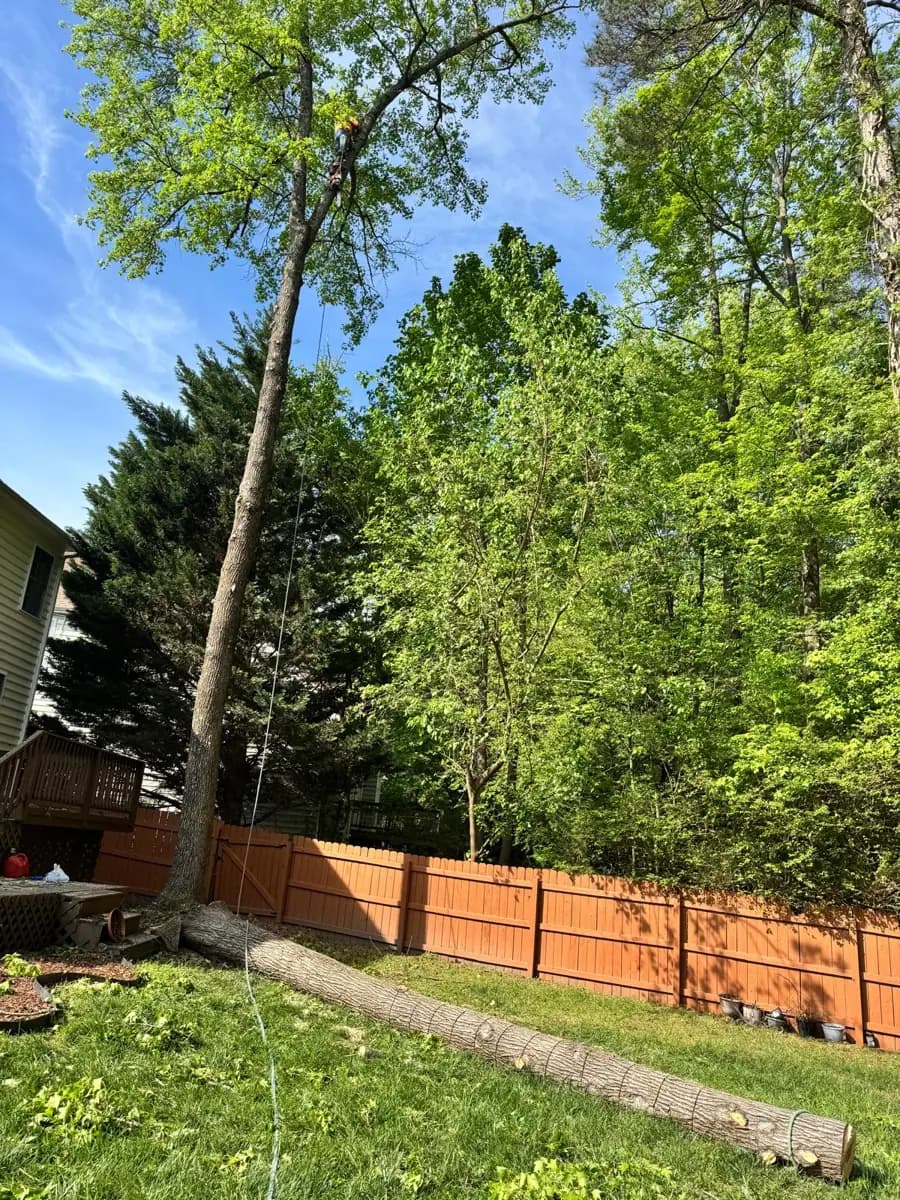
Many Hampton homes, especially near Buckroe Beach and in Phoebus, sit on small lots with houses close together. There is rarely room to drop a big tree in one piece. Instead it comes down from the top in sections, with heavy pieces lowered on rope, and the chipper is set up at the street. We plan the truck, the chipper and where the wood goes at the estimate so the job runs smoothly and the neighbors are not surprised.
A yearly checklist for Hampton yards
Once before hurricane season and once before winter, walk your property and look for dead limbs over the roof, deck, driveway and street. Check the base of large trees for mushrooms, soft wood, cavities and lifting soil. Note any tree that leans more than last year. Look along fences and the back of the lot for volunteer trees and vines before they get big. Keeping a few photos from each walk makes changes easy to spot.
Replanting near the water
If you are replacing a tree in Hampton, pick species that tolerate salt, wind and wet soil. Live oak, willow oak, bald cypress, wax myrtle, yaupon holly and eastern red cedar are good choices near the coast. Plant large trees well away from the house and overhead lines, and mulch new trees in a wide, flat ring. Water them deeply through their first two summers, because sandy soil dries out fast between storms.
Stumps, storm cleanup and lot clearing
After a storm removal, the stump is often left behind. Grinding it below the soil line lets you level the yard and replant. For overgrown back lots full of brush, vines and volunteer trees, clearing and grinding the stumps opens the space back up for mowing, a garden or a fence line.
How we work in Hampton
MG Tree Service is based in Richmond and travels to the Peninsula for jobs in Hampton, including Buckroe Beach. We plan Hampton work ahead so everything gets done in one trip, with the brush chipped and hauled away. Estimates are free, and we work seven days a week from 8 AM to 6 PM.
Text a photo of the tree and a short note about what worries you. We will tell you plainly whether it needs pruning, removal, stump grinding or just watching.
Frequently asked questions
- Are the leaning pines near Buckroe Beach dangerous?
- Not always. Many wind-shaped trees have strong roots. A lean that is getting worse, a dead top or lifting soil at the base are the signs that matter.
- Can I remove a tree near the Bay or a creek in Hampton?
- Land near the water can be in a Chesapeake Bay Resource Protection Area. Dead or dangerous trees can usually come out, but check with the City of Hampton before removing healthy ones.
- Do you work in Buckroe Beach and Phoebus?
- Yes. Both are part of our Hampton service area, along with Fox Hill, Wythe and the rest of the city.
Related services
Serving
Found this helpful? Make us a preferred source on Google.
Ready for an exact price?
Get a free, no-pressure in-home estimate. Real numbers for your home, not a phone guess.