Coastal Tree Care in Newport News: Pines, Storms and Wet Ground
· By Marcos Gomes
Newport News runs for miles along the James River and the Hampton Roads harbor, and almost every part of it has big trees close to the houses. In the older south end, around Hilton Village and Huntington Heights, the trees are old shade trees on small lots. In the north end, in Denbigh, Kiln Creek and Lee Hall, the trees are mostly tall loblolly pines left standing when the subdivisions were built.
Both kinds of yards share the same coastal conditions: strong storms from the Bay, sandy soil and a high water table. This guide explains how those conditions affect your trees, what warning signs to watch for, and when it makes sense to prune, remove or simply keep an eye on a tree.
Why coastal trees fail differently
Inland, most tree failures are a broken limb or a snapped trunk. On the Peninsula, a lot of failures are whole trees tipping over at the base. The reason is the ground. Much of Newport News has sandy or silty soil over a high water table, and roots in that kind of soil grow wide and shallow instead of deep.
When a tropical storm or a nor’easter brings days of rain before the strong wind, the soil turns soft and the root plate loses its grip. A tree that looks perfectly healthy can then lean or fall in one piece. Hurricane Isabel in 2003 showed this across Hampton Roads, with many healthy pines and oaks pulled out of saturated ground.
This does not mean every tall tree is dangerous. It means the base of the tree and the soil around it matter as much as the crown.
Tall pines near the house
Loblolly pines are the signature tree of the north end of Newport News. A healthy pine with a full green crown, straight trunk and firm ground around it handles wind well, and many of them can stay for decades.
The problems usually start when pines were left as narrow survivors after clearing, when the crown thins out, or when the top dies back. A pine that suddenly turns brown at the top, drips pitch from many small holes in the bark or develops a new lean should be looked at soon. Pine bark beetles attack stressed trees, and a dead pine dries out and becomes brittle quickly.
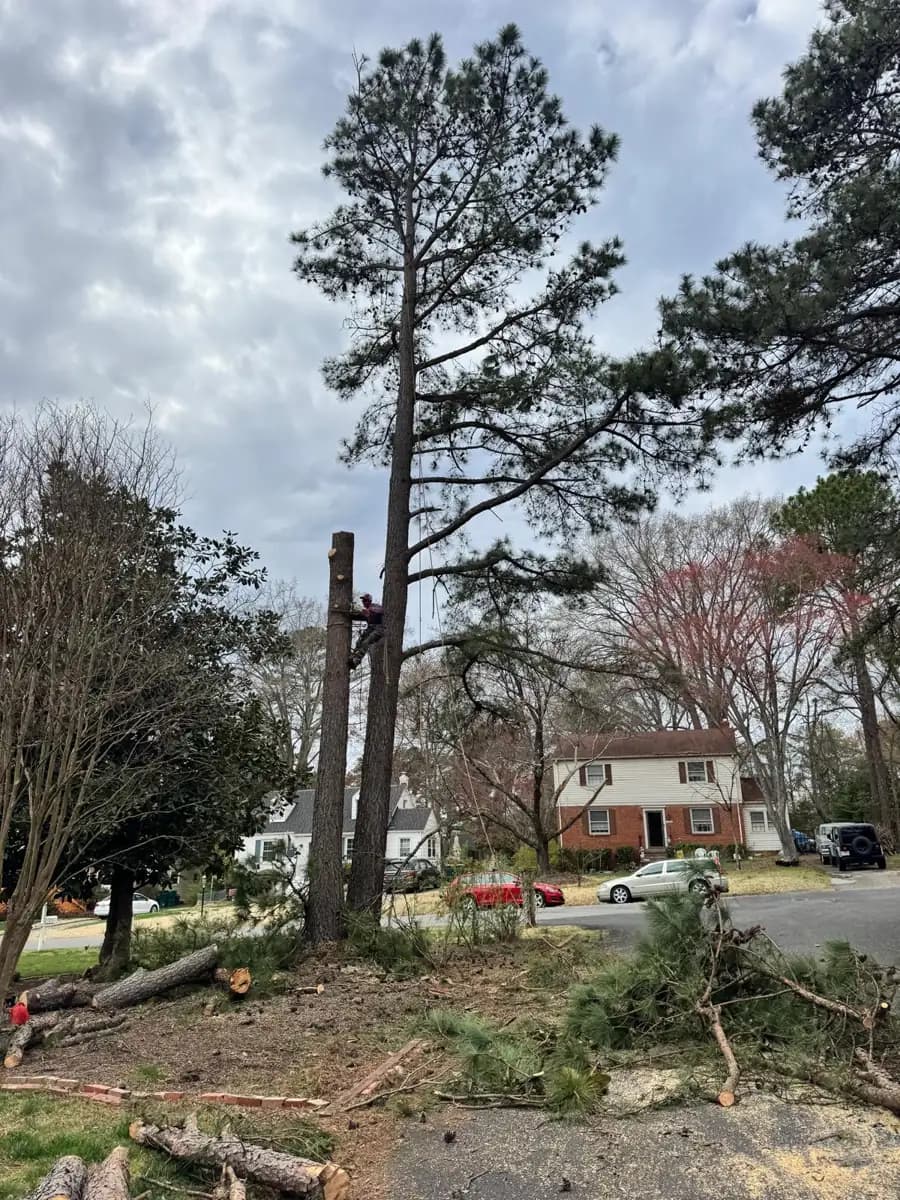
When a pine is close to the house, a pool or a fence, removal is done from the top down in sections, with pieces lowered on rope. Dropping it in one piece is only safe when there is clear room in the direction of the fall.
Old oaks in the south end
Willow oaks and water oaks shade many older Newport News streets and yards. They grow fast and get huge, but water oaks in particular are relatively short-lived, and older ones decline from the top down. Dead branches in the upper crown, mushrooms at the base and cavities in the trunk are signs that an old oak needs a careful look.
In tight neighborhoods like Hilton Village, an old oak may hang over two or three properties. Good pruning that removes deadwood and reduces heavy ends can keep a healthy oak safe for many more years. If the trunk or roots are badly decayed, removal is the safer choice.
Storm season checklist
The best time to deal with a risky tree is before hurricane season starts in early summer, and again before winter, when nor’easters arrive. Once or twice a year, walk around your yard and look up. Look for dead limbs over the roof, driveway, deck and street. Check the base of big trees for mushrooms, soft wood, cracks or soil that is lifting on one side. Note any tree that leans more than it did last year.
After a big storm, stay away from hanging limbs and leaning trees until they are checked, and call the power company for anything touching the lines. Then take photos. A photo by text is often enough for us to tell you how urgent the job is.
Wet spots, creeks and Bay buffers
Newport News is laced with creeks, ponds and marsh, and the city is covered by the Chesapeake Bay Preservation Act. Land along those waters can be inside a Resource Protection Area, a buffer where clearing trees and other vegetation is restricted.
Dead, diseased or dangerous trees can usually still be removed from a buffer, sometimes with conditions such as replanting. Healthy trees are another story. If the tree you want gone is close to a creek, pond, marsh or the river, check with the City of Newport News before any work starts. It is a quick call and it avoids problems later.
Street trees, HOAs and neighbors
Trees in the strip between the sidewalk and the street are generally the city’s responsibility. If one of those trees worries you, report it to the city rather than hiring someone to cut it.
Communities like Kiln Creek and many newer subdivisions have homeowners associations, and some want to review tree removals, especially trees visible from the street or in common areas. Ask your HOA before scheduling a removal.
When a tree hangs over a property line, the plan should keep the work on your side and the neighbor should know what is happening. We talk that through at the estimate.
Crape myrtles and smaller trees
Crape myrtles are everywhere in Newport News front yards. The common habit of cutting them back to bare stubs every year, sometimes called crape murder, weakens them and produces thin, floppy branches. Late winter thinning that removes crossing branches, suckers and dead wood keeps them healthy and blooming.
Bradford and other Callery pears were planted in many subdivisions and are now reaching the age where they split. If yours has a split trunk or heavy limbs over the house, removal is often the better choice.
Stumps and cleanup after storms
Many Newport News yards still have stumps from trees lost in past storms. Grinding a stump below the soil line lets you level the area, replant grass or put in a bed. It also removes a place for fungus and insects to live. Grinding is usually faster and less destructive than pulling a stump out with its roots.
Replanting for coastal conditions
If you are replacing a tree, choose species that handle wind and wet soil. Willow oak, swamp white oak, bald cypress, river birch and red maple all tolerate wet ground, and wax myrtle and yaupon holly handle salt and wind near the water. Keep large species well away from the house and overhead lines, give them room to grow to full size, and mulch them in a wide, flat ring instead of a volcano piled against the trunk.
How we work in Newport News
MG Tree Service is based in Richmond and travels to the Peninsula for jobs in Newport News. Because it is a longer drive, we plan each job ahead so the work gets done in one trip, with brush chipped and hauled away before we leave. Estimates are free, and we work seven days a week from 8 AM to 6 PM.
The easiest way to start is to text a photo of the tree and a short note about what worries you. We will tell you plainly whether it needs pruning, removal, stump grinding or just watching.
Frequently asked questions
- Why did a healthy tree in my Newport News yard blow over?
- Usually wet, sandy soil. Days of rain before strong wind soften the ground, and shallow roots lose their grip, so the tree tips over at the base.
- Is a pine with a brown top dangerous?
- It needs a look soon. A dying top often means stress or bark beetles, and dead pines dry out and become brittle quickly.
- Do I need permission to remove a tree near a creek?
- Possibly. Land near creeks, ponds, marsh and the river can be in a Chesapeake Bay Resource Protection Area. Check with the City of Newport News first.
Related services
Serving
Found this helpful? Make us a preferred source on Google.
Ready for an exact price?
Get a free, no-pressure in-home estimate. Real numbers for your home, not a phone guess.