9 Signs a Tree in Your Yard Is Dying or Dangerous
· By Marcos Gomes
Trees rarely fall without warning. Long before a big limb drops or a trunk snaps in a storm, the tree usually shows signs that something is wrong. The trouble is that most of those signs are easy to miss if you do not know what to look for, especially high in the canopy of a 70-foot pine or oak.
Here are nine signs worth checking on any tree that could reach your house, driveway, play area or a neighbor’s property. None of them means a tree must come down automatically, but each one is a reason to take a closer look.
1. Dead branches high in the crown
A few dead twigs are normal. Large dead limbs, especially high in the crown or over the house, are not. They are brittle, they can fall on a calm day and they often signal that the tree is declining from the top down. In spring and summer, look for branches with no leaves while the rest of the tree is green.
2. A tree that leafs out late, thin or not at all
Compare the tree to others of the same kind nearby. If it leafs out weeks later, has noticeably smaller or fewer leaves, or drops its leaves early in late summer, it is under stress. One bad year can be weather. Several in a row usually means a deeper problem.
3. Cracks and splits in the trunk
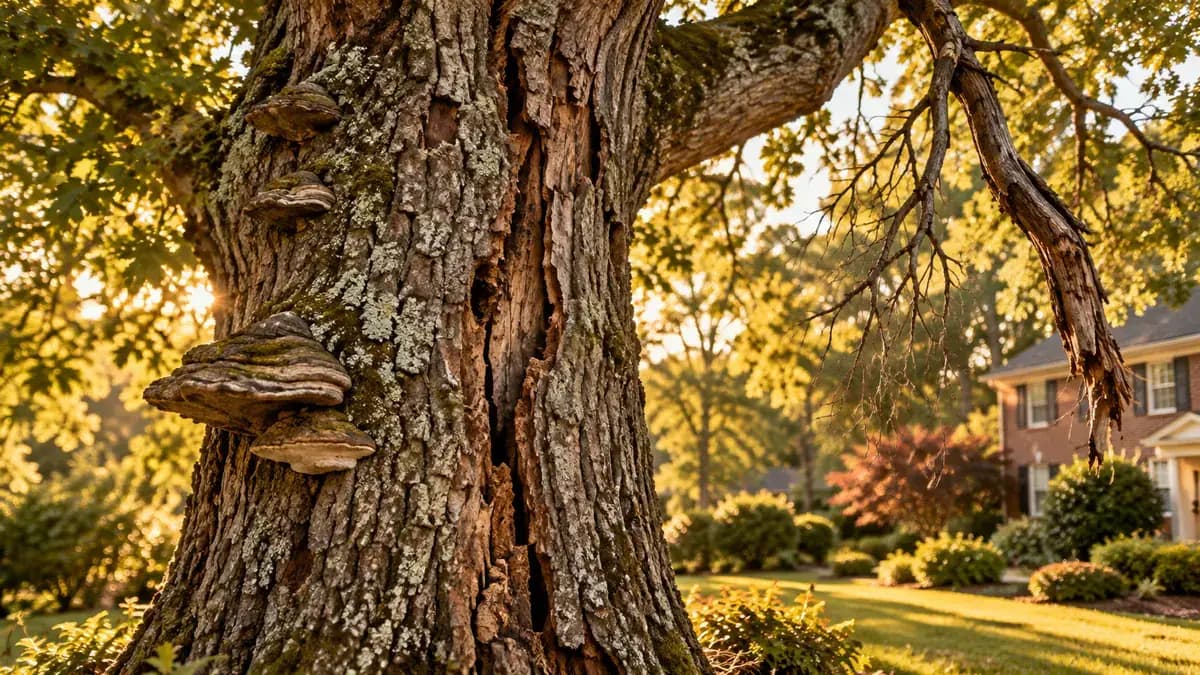
Deep vertical cracks in the trunk or major limbs are a structural warning. So are split unions, where two trunks of similar size grow from the same point in a tight V. These are common in Bradford pears and some maples, and they can split apart under wind or ice load.
4. A new or increasing lean
Many trees grow with a lean and are perfectly stable. A lean that appears suddenly, or gets worse after a storm, is different. Look at the soil on the side opposite the lean. Cracked, raised or heaving soil there means the roots are failing and the tree could go over.
5. Mushrooms and fungus at the base or on the trunk
Fungal conks, shelf mushrooms or clusters of mushrooms at the base of a tree often mean decay inside the trunk or roots. The tree can look healthy above while the wood that holds it up is rotting. Decay at the base is one of the most important signs to have checked.
6. Cavities, hollow sounds and missing bark
Large cavities, sections of missing bark and wood that sounds hollow when tapped point to internal decay. Woodpecker activity can also be a clue, since they go after insects in weakened wood.
7. Root damage
Construction is a common hidden cause of tree decline. Digging for a driveway, a new patio, a utility line or an addition can cut major roots, and the tree may start to decline one to several years later. If there was work near a tree recently, watch it closely.
8. Pines with all the weight at the top
This one is especially relevant around Richmond. Tall loblolly pines in yards often lose their lower limbs over time and carry all their foliage in a small crown at the very top. That makes them more vulnerable to snapping or uprooting in strong wind. Pines with dead tops, browning needles or pitch tubes on the bark from beetles deserve attention.
9. Ash trees in decline
The emerald ash borer has killed many ash trees across Virginia. Signs include thinning canopy, D-shaped exit holes in the bark and woodpecker damage. Dead ash becomes very brittle and dangerous to climb, so removal is easier and safer the sooner it happens.
What to do if you see these signs
Start with the target. A struggling tree in the middle of the woods is less urgent than one leaning toward the bedroom. If a tree with warning signs could reach the house, cars, a play area or a neighbor’s property, have it looked at before storm season.
Sometimes pruning out dead limbs or reducing weight is enough. Sometimes removal is the safer call. An honest look at the tree should tell you which. Around Richmond, sending a few photos is a simple way to get a first opinion.
How often to check your trees
Most homeowners only look up at their trees after a storm. A better habit is a quick walk-around twice a year: once in late winter, when the branch structure is easy to see, and once in summer, when you can compare leaf color and density. Take photos from the same spots each time. Comparing them year to year makes slow changes obvious.
Who should look at a worrying tree
For a quick opinion on whether a limb or tree is a risk, an experienced tree crew can usually tell you a lot from a walk-around. For high-value trees you want to save, or complex cases like a large tree with internal decay, a certified arborist can do a more detailed assessment and recommend treatment options.
Either way, take photos of what worries you before the visit, and note any recent changes such as construction, new lean or storm damage. That history helps whoever looks at the tree understand what is going on.
Trees near Richmond that show these signs most
Some trees show up on this list more than others in Central Virginia. Ash trees are declining from the emerald ash borer. Tall loblolly pines can lose their lower branches and end up with all their weight at the top. Old Bradford pears split. Tulip poplars drop limbs in summer storms. Water oaks often decay from the inside as they age. If you have any of these near your house, they deserve a closer look.
Free estimates if something looks wrong
If you notice one or more of these signs, MG Tree Service can look at the tree for free. We work across the Richmond area and Fredericksburg seven days a week from 8 AM to 6 PM, and we will tell you plainly whether it needs pruning, removal or just monitoring.
Frequently asked questions
- Can a dying tree be saved?
- Sometimes, if the cause is caught early and the tree is otherwise structurally sound. Pruning, mulching and watering can help a stressed tree. Advanced decay or major root damage usually cannot be reversed.
- How do I know if a tree is about to fall?
- Sudden lean, heaving soil at the base, large cracks and decay at the base are the most urgent signs. Keep people and cars away and get it looked at quickly.
- Is a tree with mushrooms at the base dangerous?
- It can be. Mushrooms at the base often indicate root or trunk decay. Have the tree evaluated, especially if it could hit a structure.
Related services
Found this helpful? Make us a preferred source on Google.
Ready for an exact price?
Get a free, no-pressure in-home estimate. Real numbers for your home, not a phone guess.