Storm-Damaged Tree? What to Do in the First 24 Hours
· By Marcos Gomes
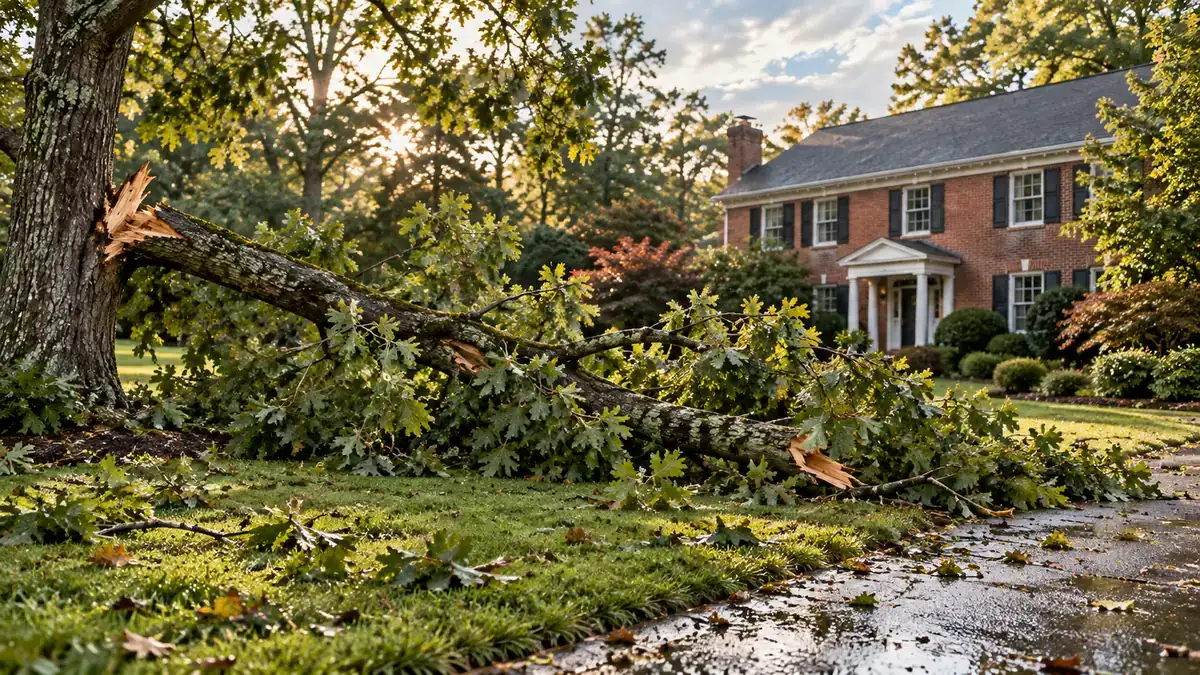
Central Virginia gets its share of severe weather: summer thunderstorms with strong straight-line winds, the remnants of hurricanes moving up from the Carolinas, and the occasional ice storm in winter. After any of them, the morning often starts with a limb on the driveway, a tree leaning against the house or a pine snapped in half across the yard.
Here is what to do, in order, when a storm damages a tree on your property.
Step 1: Stay clear and check for power lines
Before anything else, look for wires. Assume any downed or sagging line is live and dangerous. Keep people and pets well away from it and from anything it touches, including the tree and puddles. Call Dominion Energy or your electric provider to report it.
Do not try to move limbs off a line, and do not let anyone else try. Tree crews cannot safely work near energized lines until the utility has dealt with them.
Step 2: Get people out of harm’s way
If a tree is on the house, check whether anyone is in a room where the roof or ceiling is damaged and move them out. Hanging limbs, called widowmakers, can fall without warning, so keep everyone out from under the canopy of a damaged tree.
Step 3: Take photos before anything moves
If you plan to involve insurance, document everything before the tree is cut. Take wide photos showing the tree and the damage, close-ups of where it hit the house, fence or car, and the base of the tree showing whether it snapped or uprooted. These photos help the adjuster understand what happened.
Step 4: Call your insurance company
Homeowners policies often help when a tree damages a covered structure like the house or a fence, and sometimes cover removal of the part of the tree that hit it. A tree that fell in the yard without hitting anything is often not covered. Every policy is different, so call your insurer, describe the damage and ask what they need.
Keep receipts for any emergency work, like tarping a roof, since those costs may be reimbursable.
Step 5: Call a tree company you can trust
Removing a tree from a damaged roof or a tangle of broken trees is some of the most dangerous work in the trade. The tree is under tension in unpredictable ways. It should be handled by people who do this every day, with rope, rigging and a plan for every piece.
Be careful with storm chasers who appear right after a big event asking for cash up front. A local company with a phone number that will still work next month, and a written price, is the safer choice.
Step 6: Look at the rest of the trees
Once the immediate problem is handled, walk the property. Storms often crack limbs that do not fall right away, loosen roots on leaning trees and leave broken tops hanging high in pines. Those are the trees that come down in the next storm.
The best storm plan is the one you make before the storm: having tall trees near the house looked at before the summer and hurricane seasons.
Preparing before the next storm
The best way to handle storm damage is to prevent as much of it as possible. In late winter or spring, walk your property and look for dead limbs over the roof, cracked trunks, trees leaning toward the house and pines with dead tops. Having those dealt with before hurricane season costs less than an emergency removal and protects the house.
Keep a list of who to call ready: your insurance company, the electric utility and a local tree company. When a storm hits, you will not have to search for numbers while dealing with the damage.
Dealing with partial damage
Not every storm-damaged tree has to come down. A tree that lost a few limbs but kept a solid trunk and most of its canopy can often be saved with cleanup pruning: removing broken stubs, cutting torn limbs back to clean wounds and taking out hanging branches. Clean cuts close better than ragged breaks.
Trees that split at the main trunk, lost most of their canopy or had their root plate lift out of the ground are usually not worth saving near a house. If you are unsure, have the tree looked at before deciding, especially if it stands over the roof or the driveway.
Why Central Virginia sees so much storm damage
The Richmond area sits in a spot where several kinds of weather hit trees. Summer thunderstorms bring sudden straight-line winds. Remnants of tropical storms and hurricanes move up from the Carolinas in late summer and fall, soaking the ground and then adding wind, which is the worst combination for shallow-rooted trees. Winter ice storms coat branches and add weight that many trees cannot carry.
Tall loblolly pines, tulip poplars, old water oaks and Bradford pears are the trees we see fail most often after these events.
Leaning trees and hung branches
Not all storm damage is a tree on the ground. A tree that is suddenly leaning, with soil lifted or cracked on one side of the base, may have broken roots and can fall days later. A large branch caught in the canopy above, often called a hanger, can drop without warning. Both should be treated as urgent. Keep people and cars out of the area and have them handled before anyone works or plays underneath.
Should you cut it yourself?
A small limb on the lawn is easy to cut and stack. Anything touching the house, wires or another tree is different. Storm damaged wood is under tension, and when it is cut it can spring or roll in ways that are hard to predict. Chainsaw injuries go up after every big storm for this reason. If the tree is large, leaning on something or hard to read, let a crew with ropes and rigging handle it.
Cleanup after the emergency is over
Once the dangerous part is handled, there is usually cleanup left: brush, broken limbs in other trees, a stump and torn turf. Grinding the stump and refreshing beds with mulch helps the yard recover faster. MG Tree Service handles the removal, the cleanup, the stump grinding and the mulch, and gives free estimates seven days a week from 8 AM to 6 PM.
Frequently asked questions
- Who pays if my neighbor’s tree falls on my house?
- In many cases your own homeowners insurance handles damage to your house, regardless of whose tree it was. If the tree was clearly dead or dangerous and the neighbor knew, liability can be different. Ask your insurer.
- Can I cut up a fallen tree myself?
- Small limbs on open ground, maybe. Trees on structures, under tension or near wires should be left to professionals.
- How quickly should a tree on my roof be removed?
- As soon as it can be done safely, to limit water damage. Tarp the roof once the weight is off.
Related services
Found this helpful? Make us a preferred source on Google.
Ready for an exact price?
Get a free, no-pressure in-home estimate. Real numbers for your home, not a phone guess.