Living in the Woods at Woodlake: Tree Safety Around Your Home
· By Marcos Gomes
Woodlake’s appeal is easy to see: winding streets, lake views and homes tucked into mature forest around Swift Creek Reservoir. The trees are what make it feel like a retreat.
They also stand closer to houses than in most neighborhoods, and many have never been pruned since construction. This guide helps Woodlake homeowners think about which trees deserve attention and how to manage a wooded lot responsibly.
Map the trees that can reach your house
Start with a simple exercise. Walk around your home and note every tree whose height is greater than its distance to the house, deck or driveway. Those are the trees that could reach something important if they fell. On many Woodlake lots that list includes several tall loblolly pines, oaks and tulip poplars.
Being on the list does not mean a tree is dangerous. It means it deserves a closer look each year.
What to look for on those trees
For pines: dead or brown tops, a small crown perched on a long bare trunk, new lean, cracked soil at the base and resin tubes or holes in the bark. For hardwoods: large dead limbs, cavities, fungus at the base and cracks in the trunk or major unions.
Trees damaged during construction years ago, with roots cut for foundations, driveways or utilities, sometimes decline slowly and fail later. If a tree near the house has been thinning year after year, have it checked.
Thinning instead of clear-cutting
Many owners want more light for a lawn or garden without losing the wooded feel. Selective thinning does that. Remove the weakest and riskiest trees, the ones crowding each other and the volunteers in the understory, and keep the healthiest, best-shaped trees. Grinding the stumps afterward makes the cleared spots usable.
Opening a stand suddenly can expose remaining trees to more wind, so it is better to thin thoughtfully than to remove everything around one tree.
The reservoir and the HOA
Swift Creek Reservoir supplies drinking water, and areas near the shoreline and streams can have additional protection under Chesterfield County and Chesapeake Bay rules. Clearing vegetation inside those buffers is restricted. If a tree is close to the water, check with the county before removing it.
Woodlake’s community association also has guidelines for exterior changes, and tree removals can fall under them. A quick check before scheduling avoids problems.
Storm season planning
Summer thunderstorms and the remnants of tropical systems are the main threats. The most cost-effective step is dealing with the obvious problems in late winter or spring: dead tops, hanging limbs and trees leaning toward the house.
After a storm, stay away from trees with hanging limbs and from any downed lines, and call for help before trying to cut anything under tension.
Tree work in Woodlake
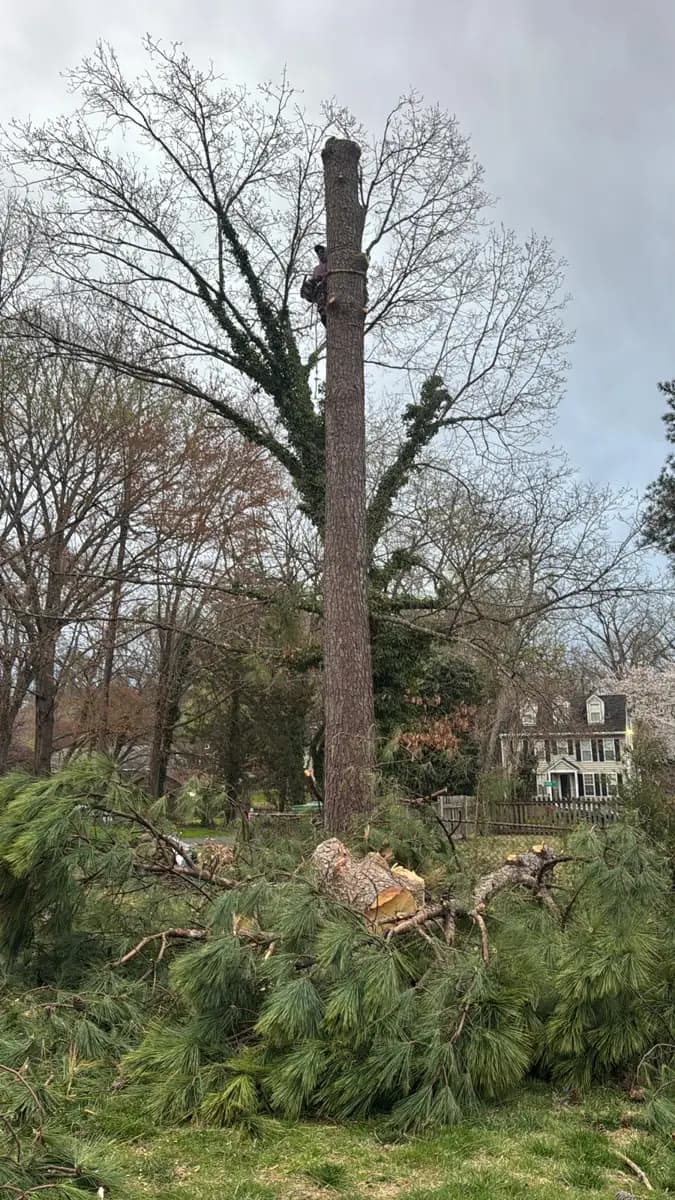
Most Woodlake removals require climbing and rigging because there is little open space. We take trees down in sections, lower heavy pieces on rope and chip the brush on the driveway. Send photos of the trees that concern you and we will plan a visit.
A seasonal routine for wooded lots
In late winter, walk the lot and note dead tops, hanging limbs and leaning trees within reach of the house. In spring, clear gutters of pine needles and check that downspouts drain away from foundations. In summer, keep an eye on tree health during dry spells and water young trees deeply. In fall, rake or mulch leaves and schedule any removals for the dormant season.
This routine takes a few hours a year and catches most problems while they are still easy and affordable to fix.
Gutters, roofs and decks under the canopy
Living under tall trees means extra maintenance on the house itself. Pine needles and oak leaves fill gutters quickly, so cleaning them in late fall and again in spring keeps water flowing away from foundations. Branches touching the roof wear down shingles and give squirrels an easy way into attics, so keeping limbs trimmed back from the roofline helps.
Decks in shaded, wooded lots stay damp and grow mold and algae faster. Raising low limbs and thinning a little of the canopy lets in more light and air, which keeps decks and siding cleaner and makes the yard feel less closed in without removing the trees that make Woodlake what it is.
Common trees in Woodlake yards
Most Woodlake lots were cut out of mixed pine and hardwood forest, so the trees around your house are usually loblolly pines, white and red oaks, tulip poplars, sweetgums and red maples, with dogwoods and hollies in the understory. Each behaves differently. Loblolly pines grow tall and straight with most of their weight at the top, which makes them catch wind. Tulip poplars grow fast and can drop large limbs in summer storms. Oaks are long lived but react badly when their roots are cut or buried during construction.
Knowing what you have helps you decide what to watch. A healthy oak thirty feet from the house is usually an asset. A tall pine with a thin crown leaning toward the roof is a different conversation.
What thinning a wooded lot actually involves
Thinning means removing the weakest, most crowded or most dangerous trees and keeping the best ones. On a typical Woodlake lot that might mean taking out a few pines that lean toward the house, a dead tree in the back corner and some crowded saplings, while keeping the strongest oaks for shade and privacy.
The work is usually done in one or two days. Trees near the house are taken down in sections and lowered with ropes, so nothing drops on the roof, deck or fence. The wood can be cut into firewood lengths, chipped or hauled away, and stumps can be ground below grade so the area can be mulched or seeded.
Getting a free estimate in Woodlake
If you are not sure which trees around your house should stay, a walk-through is the easiest way to find out. MG Tree Service gives free estimates and works seven days a week from 8 AM to 6 PM, so it is easy to find a time when you can be home. We will point out the trees that look fine, the ones worth pruning and the ones that should come out, and you decide from there.
Frequently asked questions
- Can I remove trees near the water in Woodlake?
- Shoreline and stream buffers may be protected. Check with Chesterfield County and the association first.
- How do I know if a pine near my house is risky?
- Dead top, new lean, cracked soil at the base and a small crown on a long bare trunk are the main warning signs.
- Does thinning trees help with storms?
- Removing weak and dead trees reduces risk, but thinning should be planned so the remaining trees are not suddenly over-exposed.
Related services
Serving
Found this helpful? Make us a preferred source on Google.
Ready for an exact price?
Get a free, no-pressure in-home estimate. Real numbers for your home, not a phone guess.